
HACCP-FAQs

HACCP FAQs
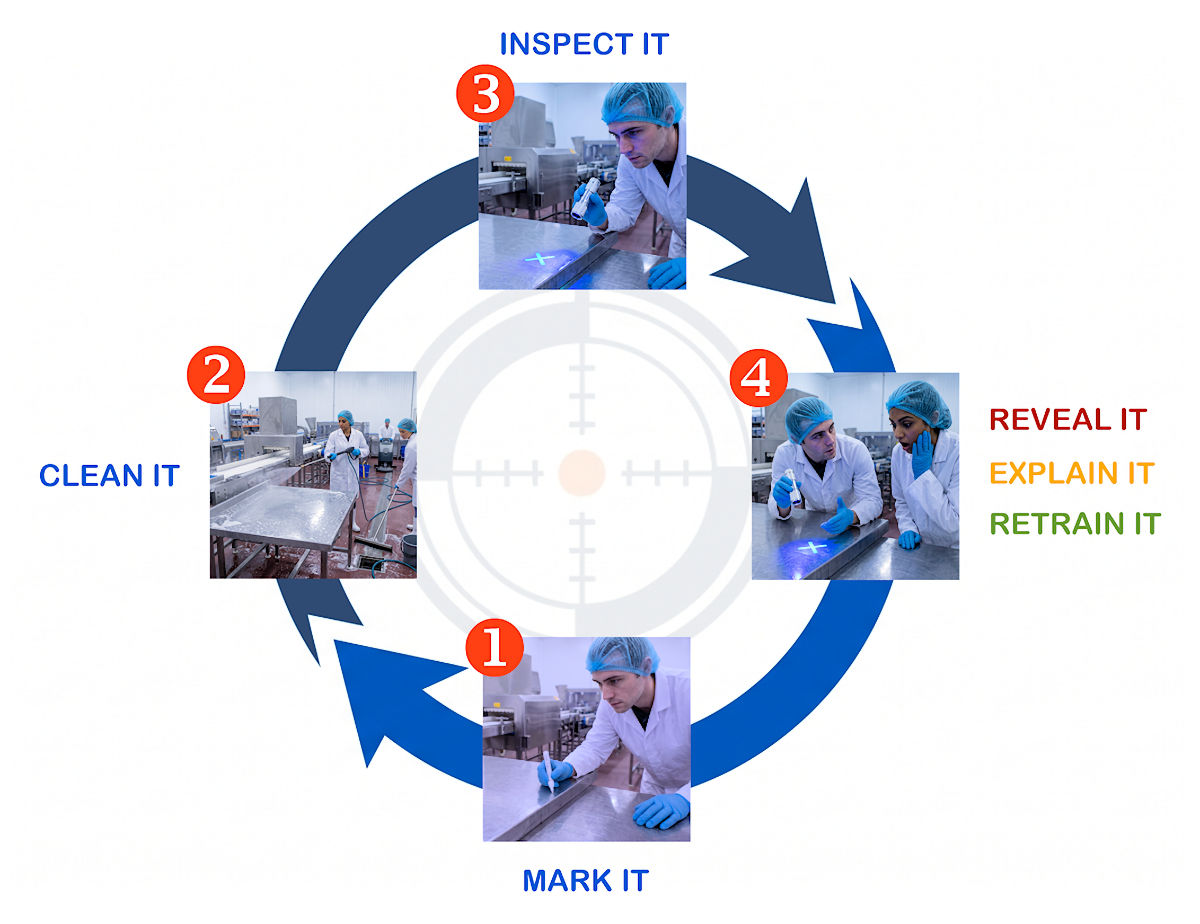
1. One of several secret ‘audit’ marks is made using an appropriate CHECKPOINT UV Tracer (Gel, Oil, Grease, Spray, Powder or Emulsion) on a designated worksurface, cooler handle, control panel or knife handle etc. The location and type of each mark made is recorded in the Cleaning Inspection Audit Log.
2. Daily post-production / end-of-day clean-down proceeds as normal.
3. A post clean-down UV inspection reveals one or more minor cleaning failures.
4. The QA Manager ‘visually’ reveals cleaning failure to colleague(s) responsible and politely explains how and why it occurred. Corrective re-training is then provided to avoid any recurrence.
– Update the Cleaning Inspection Audit Log with the results.
Whilst this is a rather simplistic example of CHECKPOINT Visual Hygiene Training in action, it still serves to explain it well.
The CHECKPOINT UV Tracer range is designed to serve as an invisible, objective benchmark for validating cleaning thoroughness and physical SSOP execution. While traditional sensory inspections (visual and tactile) often miss microscopic biological soils, chemical biofilms, and allergen cross-contact paths, CHECKPOINT formulations physically mimic these organic soils and contamination vectors to verify that manual and automated cleaning protocols actually achieve a full clean-down.
- Pillar 1: The Human Factor (Personal Hand-Hygiene Mastery): Here we use UV GERM™ training lotions and gels paired with the SHOWBOX PRO™ visual training booth. Staff apply the lotion, wash their hands as normal, and place them inside the booth under safe UV light. Any missed spots instantly glow a brilliant, fluorescent green. This visual self-correction completely bypasses language and literacy barriers on multilingual shift lines, building automatic muscle memory for correct hand scrubbing and glove handling.
- Pillar 2: The Surface Factor (Environmental Surface Verification): Here we deploy CHECKPOINT™ UV Tracers designed to physically mimic real-world food soils like starch powders, sticky gels, liquid oils, and heavy greases on your machinery and touchpoints. Quality supervisors apply an invisible “secret” mark before a clean-up shift. If a spot is skipped, it glows unmissably under a calibrated 365 nm UV-A torch. This enforces an unyielding 0.0% Zero-Glow Standard—if it glows, it must be re-cleaned.
Under the CHECKPOINT 0.0% SSOP Clean-Down Protocol, a cleaning cycle is only considered validated when there is absolute 0.0% visual fluorescence retention under a 365 nm UV light source post-sanitation. Any remaining fluorescent signal flags an immediate failure in mechanical scrubbing, chemical concentration, temperature, or contact time, requiring an instant lock-out and re-clean.
Select your medium based on the physical properties of the soil you are trying to mimic:
UV Tracer: Ideal for high-touch surfaces, hand audits, control knobs, and tactile transfer points.
UV Gel: Best for wet lines, stagnant fluid zones, drain channels, mixing kettle rims, and pump housings.
UV Grease: Formulated for heavy animal fats, industrial lubricants, bearings, gearboxes, and conveyor drive shafts.
UV Spray: Designed to mimic aerosolized moisture, fine splatters, and air movement across ventilation hoods, overhead framing, and undersides.
UV Marker: Used for localized chemical residues or proteinaceous films on slicer blades, continuous belts, and internal threads.
UV Powder: Specifically for dry allergens (gluten, soy, nuts) and dust transfer in blenders, sifting screens, and airlock transitions.
Rather than replacing one another, CHECKPOINT UV Tracers and ATP Swab Testing work as a complementary, two-tier verification system:
CHECKPOINT UV Tracers (Behavioral & Physical Validation): Audit whether staff physically scrubbed, wiped, or reached target zones. They provide instant visual feedback across broad, complex areas at a very low consumable cost.
ATP Swabbing (Biochemical Verification): Quantifies organic debris and microbial residue (Relative Light Units) on food contact zones immediately prior to production runs as a quantitative gate check.
Using CHECKPOINT tracers ensures that sanitation staff do not skip physical contact points, while ATP testing verifies that the disinfected food-contact surface is biologically clean.
Risk Assessment: Select critical points (CCPs) or historically problematic zones and match the appropriate tracer medium.
Target Inoculation: Apply the tracer (covertly or transparently) to target surfaces pre-sanitation. Allow markers 3–5 minutes to dry.
Operation/Dwell: Allow the line to run or sit to simulate production stresses.
SSOP Clean-Down: Have the sanitation team execute the standard cleaning shift.
UV Inspection: Darken the area, equip UV safety eyewear, and scan the surfaces with a 365 nm UV inspection lamp held 10–30 cm away.
Scoring & Action: Apply the 0.0% standard. Any residual glow requires an immediate lock-out and re-clean.
Under HACCP Principle 6 (Verification) and GFSI standards (such as BRCGS, SQF, or IFS), CHECKPOINT tracer audits provide objective, trendable evidence of hygiene process control:
Verification Evidence: Completed UV audit logs serve as empirical proof that your sanitation procedures are actively validated and routinely audited.
Trend Analysis: Aggregating monthly zone scores enables QA Managers to identify structural equipment hazards (e.g., hard-to-clean welds, worn gaskets) or specific shift gaps.
Record Retention: Audit records should be retained for a minimum of 24 months to satisfy third-party audit requirements and support continuous improvement logs.
Use the TACT framework to identify why the sanitation process failed:
T – Time (Contact/Dwell Time): Detergent or sanitizer was rinsed off too quickly. Fix: Increase foam dwell time or extend automated CIP loops.
A – Action (Mechanical Force): Physical scrubbing, water pressure, or fluid velocity was insufficient to remove the soil matrix. Fix: Audit operator scrubbing technique or check for worn brushes/clogged spray nozzles.
C – Chemical (Concentration/Type): The cleaner concentration was too weak or mismatched to the soil type (e.g., using basic water on heavy fats). Fix: Adjust chemical titration or upgrade to a chlorinated alkaline cleaner.
T – Temperature (Thermal Energy): The wash water was too cold, causing fats to congeal and smear rather than melt away. Fix: Ensure wash cycles consistently hit target temperatures (typically 60–65°C).
Using CHECKPOINT UV Powder (10% active) allows you to simulate dry allergen movements (such as wheat flour, soy isolate, or nut powders). By dusting ingredient hoppers, sifting screens, or operator garments, a UV light inspection post-run will clearly expose:
Powder migration via airborne currents or static electricity.
Cross-contamination spread via operator uniforms or foot traffic moving between zones.
Hidden allergen traps in blender valves, chute lap-joints, and sifter clamping rings.
CHECKPOINT tracers are non-hazardous validation aids designed primarily for SSOP training and auditing. When applied near or on direct food-contact surfaces during designated validation trials, a complete SSOP clean-down and verification inspection must be executed post-audit to ensure 0.0% residue remains before standard food production resumes.
Eye Protection: Never look directly into the primary beam of a 365 nm UV light source. Always wear EN 170-compliant UV-blocking protective eyewear.
Storage: Keep tracer containers tightly sealed in a cool, dark location away from direct sunlight to preserve their fluorescent intensity over time.
No. The CHECKPOINT guide provides a best-practice validation framework only. It does not supersede or replace your facility’s validated Standard Operating Procedures (SOPs), Sanitation Standard Operating Procedures (SSOPs), or certified Food Safety Management Systems (such as BRCGS, SQF, or FSSC 22000), which retain ultimate precedence.
CHECKPOINT UV Tracers act as an operational diagnostic tool to identify physical cross-contamination vectors before conducting costly microbiological or pathogen swabs. By applying tracer powder or spray to high-risk transition boundaries (e.g., foot traffic routes, drain splash zones, or forklift paths), QA teams can map physical movement and airborne drift. Uncovering these transmission pathways under UV light allows you to refine your EMP sampling points to focus precisely on newly identified harborage and transfer sites.
he surface substrate directly influences cleanability and removal effort:
Polished Stainless Steel (316/304): Offers rapid release; ideal for establishing baseline SSOP cleanliness.
Rough Welds, Pitted Metals, & Porous Polymers: Retain tracer particles longer, exposing micro-fissures and worn equipment that harbour soils.
Silicone Gaskets & Soft Seals: High-viscosity mediums like UV Grease or Gel can absorb into degraded elastomers, signaling that a gasket replacement is necessary.
To validate automated systems:
CIP Systems: Apply UV Marker or UV Grease to internal target points (e.g. spray ball shadow zones, pipe union gaskets, or agitator undersides) prior to running a CIP loop. Post-cycle disassembly and UV inspection verify whether flow velocity, chemical concentration, and thermal energy successfully reached 100% of internal contact points.
COP Tanks: Coat internal threads and complex component geometries before immersion washing to confirm that chemical agitation and dwell times are sufficient.
Yes. Unannounced tracer inoculation before third-party sanitation shifts provides a quantitative, objective audit of service quality. By logging historical pass/fail metrics using the Overall Zone Cleaning Score formula, QA managers can establish binding Key Performance Indicators (KPIs) in service level agreements (SLAs), verify contract compliance, and justify billing deductions for inadequate clean-downs.
CHECKPOINT mediums are formulated to mimic specific organic food soils under realistic thermal conditions:
- High-Temperature Processing & Cook Lines (>38oC): UV Grease transitions from a semi-solid paste to a liquid film above its melting point (38oC -56oC). This accurately mimics the physical flow and migration of rendered animal fats, hot oils, and melted lipids across equipment frames and seals.
- Ambient & Refrigerated Operations (<25oC): UV Grease maintains a high-adhesion, tacky paste structure that simulates heavy food grease, lard, or industrial lubricants.
- Refrigerated & Cold Zones (<4oC): Water-based mediums like UV Spray and Marker dry slower due to reduced ambient evaporation rates. Allow an additional 5–10 minutes drying time pre-audit to ensure complete film formation.
- Sanitation Water Temperature: Cleaning cycles for UV Grease must utilize hot water flushes (60oC-65oC) combined with emulsifying degreasers. Rinse water below the 38oC melting threshold will cause grease smearing and fail the 0.0% clean-down standard.
When stored in original sealed containers in a cool, dry location away from direct sunlight. Prolonged exposure to intense ambient UV radiation or direct sunlight inside storage areas can degrade the fluorescent active brighteners over time. Always close caps and spray nozzles tightly after use to prevent carrier evaporation.
When finished goods are held for hygiene or soil contamination issues, unannounced tracer trials can isolate the exact breakdown in the production line. By applying specific mediums up-stream (e.g., UV Gel on pump seals or UV Spray on overhead frameworks) and running test cycles, QA managers can pinpoint whether the contamination stems from mechanical seal bypass, structural condensation drips, or human operator error during sanitation.
Yes. All formulations within the CHECKPOINT range are manufactured using REACH-compliant, non-hazardous, cosmetic- or pharmaceutical-grade components. Safety Data Sheets (SDS) are available for each medium, confirming they do not contain SVHCs (Substances of Very High Concern), heavy metals, or hazardous solvents.
Over-cleaning or using excessive chemical concentrations increases operational costs and wastewater load. Tracers establish the exact minimum threshold of chemical concentration, water temperature, and mechanical action required to achieve a 0.0% clean-down. By testing incremental reductions in wash time or chemical titration against tracer removal, QA managers can optimize resources without compromising hygiene standards.