
SFBB-FAQS

The CHECKPOINT™ range consists of invisible, non-toxic fluorescent tools designed to help you test whether your kitchen cleaning and handwashing routines actually remove hidden dirt, grease, and germs. Under normal light, the tracer is invisible, but under a special UV torch, it glows brightly, showing you exactly where staff missed a spot during clean-down.
Not quite, but then most food-soils are not invisible either and our UV tracers are designed to mimic food-soil characteristics. Under normal use, Checkpoint Tracers are ‘inconspicuous’ but their visibility depends on the tracer used and the nature and colour of the surface it is applied to.
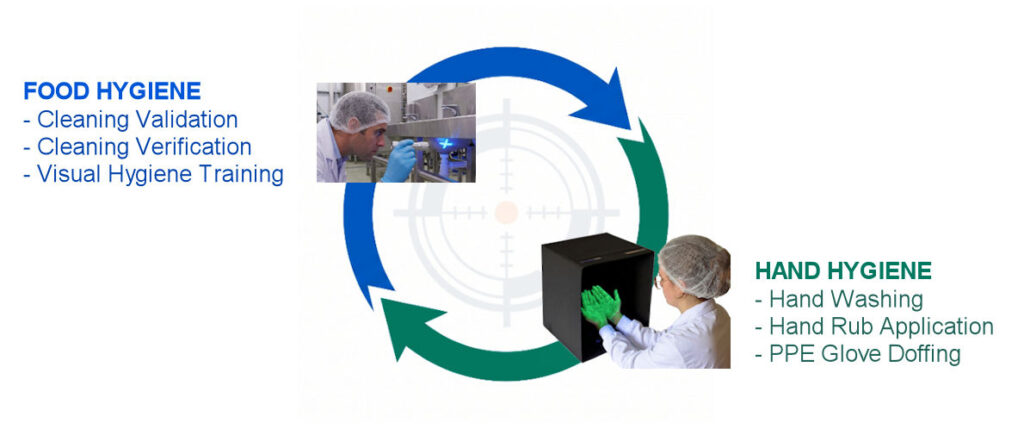
Combine the CHECKPOINT UV Tracer Range with the SHOWBOX Visual Hygiene Training (VHT) System for complete cross-contamination control. While CHECKPOINT validates surface clean-downs and touchpoint hygiene, the SHOWBOX trains staff in flawless handwashing and PPE practices. When used in conjunction with your existing food-safety controls, they help your business achieve a 360° hygiene defence.
Yes, absolutely. All Checkpoint™ formulations are non-toxic, non-hazardous, biodegradable, and safe for standard commercial kitchen surfaces. The carrier bases are manufactured in the UK using premium cosmetic-grade and pharmaceutical-grade ingredients (such as vegetable glycerin, highly refined mineral oils, and native starches) However, they are classified as auditing and training aids—they are not food ingredients, food additives, or consumable substances and should never be eaten or added to recipes.
No. Every product in our range is certified 100% allergen-free under UK Food Information Regulations (FIR 2014) and EU Regulation 1169/2011 Annex II. They contain absolutely none of the 14 major global food allergens, meaning they are completely free from gluten, nuts, dairy, soy, eggs, and sesame. They can be safely deployed in high-care kitchens that cater to customers with severe allergies to map dust and cross-contact risks.
Only during dedicated cleaning audits and training shifts. While our tracers are chemically inert and safe for skin contact, they must never come into contact with raw ingredients or active food batches. The correct sequence is simple.
- Apply a microscopic, invisible dot or light spray to your target surfaces prior to a closing shift or deep clean.
- Let staff carry out their standard cleaning routine.
- Scan the surfaces with your 365 nm UV torch.
- Once the audit is logged, ensure the area has been washed down to a 0.0% Zero-Glow Standard before active food preparation restarts.
Under the SFBB framework, a station, utensil, or machine is only validated as truly clean when there is absolute 0.0% visual fluorescence under a 365 nm UV-A inspection light. If you scan a surface and see even a tiny speck or smudge of glowing tracer, the check is a FAIL.
The area must be locked down, cleaned again, and re-checked until the glow is completely gone before any food prep begins.
- Checkpoint Powder: Replicates dry ingredients (flour dust, spices, baking starches, and dry allergens).
- Checkpoint Gel: Replicates sticky, wet soils (raw meat/poultry juices, egg whites, honey, and thick sauces).
- Checkpoint Grease: Replicates stubborn, hydrophobic fats (cooker hood grime, lards, butter, and machinery lubricants).
- Checkpoint Oil / Oil Spray: Replicates liquid lipids (frying mist, salad dressings, and liquid cooking oils).
- Checkpoint Spray: Replicates wide-area splashes (sink back-splashes, hose washdowns, and liquid spills).
- Checkpoint Marker: Best for quick, invisible “secret shopper” checks on dry hand-contact points (fridge handles, buttons, taps).
We have a range of ready-to-use CHECKPOINT Mini Training Kits – geared to each ‘Food Business’ type. Just choose the one that best matches what you do.
- For UV Powder: Always dry-clean first. Use a HEPA-vacuum or a dry static microfiber cloth to lift the loose starch particles before applying liquids. Applying water directly onto dry starch turns it into a sticky, adhesive paste that binds into grout and crevices.
- For UV Gel, Spray, and Marker: These are highly water-dispersible and wipe away cleanly using standard warm soapy water, a kitchen sanitiser spray, or a damp microfiber cloth.
- For UV Grease and UV Oil: Being waterproof, they will smear if wiped with cold water. They require warm-to-hot water (>40°C for oil, and 56°C for grease) combined with an active kitchen degreaser or detergent to emulsify and lift the oil base.
- Surface Damage: The material being tested is highly micro-porous or scratched (such as deeply scored plastic chopping boards, unsealed tile grout, or degraded rubber seals) and has absorbed the tracer particles. This proves the surface is compromised and is likely harboring dangerous, microscopic bacteria that standard cleaning can no longer reach.
- Incorrect Chemistry: Your detergent dilution may be too weak, or your water is too cold to break down the grease or oil carrier base. Adjust your water temperature (ensure it is hot) or use a proper emulsifying kitchen degreaser
Environmental Health Officers (EHOs) inspecting your business under SFBB want to see proof that your cleaning schedules and hygiene policies work in practice, not just on paper. Using CHECKPOINT™ tools gives you clear, visual evidence to show EHOs that you regularly audit your staff, verify your cleaning procedures, and train your team to high standards.
Match the product medium to the type of spill or soil you are trying to simulate:
Powder: Mimics dry ingredients like flour, spices, and dry allergen dusts.
Marker: Ideal for drawing discrete audit marks on door handles, fridge seals, and light switches.
Spray: Perfect for checking splash-zones, tiles, and large flat surfaces like stainless-steel counters.
Gel: Simulates wet, sticky food residue in drains, sink taps, or blender bases.
Grease: Mimics heavy cooking oils, animal fats, and grease traps.
The target is simple: Zero Glow (0.0% Fluorescence). After your staff finish their normal cleaning routine, scan the area with the 365 nm UV torch. If any area still glows, the surface wasn’t cleaned properly and must be wiped or scrubbed again.
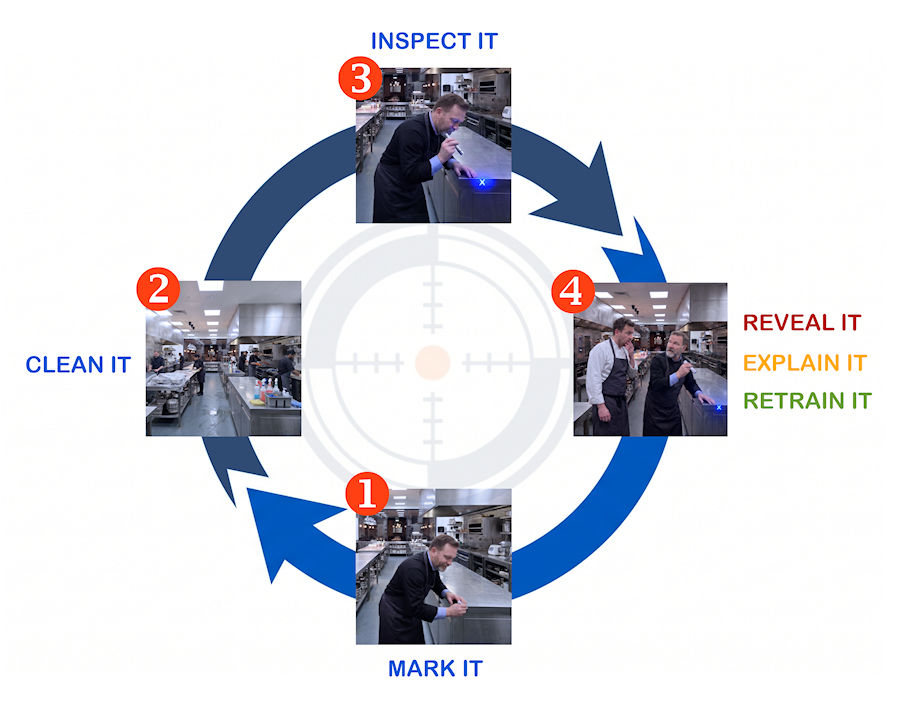
Mark: Before staff begin their cleaning shift, secretly place a small dot or mist of tracer onto target areas (e.g fridge handles, prep table undersides, or slicing blades).
Clean: Let staff carry out their standard cleaning routine as usual.
Inspect: Darken room lighting and shine the UV torch over the marked spots.
Review: If the mark is completely gone, the cleaning pass is verified. If it glows, show the employee where they missed so they can re-clean it immediately.
Allergen cross-contamination often happens without staff realising it, for example, carrying flour dust across prep tables on hands or aprons. Dusting a small amount of CHECKPOINT™ Powder on a dry ingredient bin shows staff under UV light how easily fine particles travel across clothing, utensils, and countertops.
Yes. All CHECKPOINT products are manufactured in the UK using non-toxic ingredients. They are 100% free from all major food allergens (such as nuts, gluten, dairy, and soy). While non-toxic, they are auditing tools, so you should always perform a 0.0% Zero-Glow clean-down after an audit before preparing food.
Language barriers, poor habits and high staff turnover can make written hygiene rules hard to enforce. Seeing invisible “dirt” glow under a UV torch creates an instant “aha!” moment for kitchen staff. It builds visual memory so staff naturally pay attention to “blind spots” like under table rims, tap handles, and control knobs.
For New Staff: Use tracers during their first week of onboarding to train them on handwashing and surface cleaning.
Routine Checks: Run weekly or monthly spot-checks on high-risk touchpoints.
After EHO Visits / Incidents: Use them immediately if an inspection flags cleaning issues or if menu changes introduce new major allergens.
All you need is a high-intensity 365-380 nm UV Forensic torch. Standard purple novelty UV lights or high-wavelength blue LEDs won’t excite the tracer properly. For eye comfort during longer inspections, auditors can wear simple UV-blocking safety glasses. Where possible, darken the immediate area so it is easier to see the fluorescent glow of the UV Tracer.
Yes, applying a small dab of UV GERM Training lotion or UV GERM Hand-Rub Training Gel to a new staff member’s hands before they wash them reveals hidden missed areas—such as between fingers, under fingernails, and around wrists etc. When inspected under UV light. It creates an instant visual lesson that reinforces proper hand hygiene practices immediately and circumvents language barriers!
No. All CHECKPOINT formulations are non-staining and designed for standard commercial kitchen surfaces. Water-soluble mediums (Spray, Gel, Marker) wipe off easily using standard warm water and detergent wipes. For non-porous surfaces like stainless steel, tiles, and heavy plastics, they leave zero trace once cleaned properly.
EHO inspectors evaluate how well your cleaning schedule works in reality. Using CHECKPOINT tools regularly allows you to spot hidden grease, water traps, and missed cleaning spots before the inspector does. Showing an EHO your logged UV audit spot-checks proves that your business actively verifies its hygiene standards rather than just filling out paperwork.
A persistent glow indicates that your current cleaning method needs adjustment. Check the following:
Detergent Strength: Is the dishwashing liquid or degreaser diluted too much?
Water Temperature: Is the water hot enough to melt grease and fat?
Scrubbing Action: Are staff using a cloth when a stiff brush or scraper is needed? Adjust these elements and re-clean until the surface reaches absolute Zero Glow.
Use the CHECKPOINT™ Grease, Marker or Gel (depends on the nature of food you work with)
Use the Marker to draw thin marks on internal slicer blades, adjustment dials, and thread gaps.
Use the Grease or Gel on blender blade seals, rubber gaskets, and base units. If glowing residue remains after standard wash-up, the machine must be dismantled for deep cleaning.
Yes. Every product in the CHECKPOINT range is manufactured in the UK and is 100% free from all major food allergens (including nuts, gluten, dairy, soy, and sesame). The UV Powder base is made from certified gluten-free cornstarch, making it completely safe for auditing allergen cross-contact risks.
No. Novelty blacklights or broad-spectrum blue LEDs operate at the wrong wavelength and lack the intensity needed to excite the tracer particles accurately. You must use a dedicated 365-380nm UV Forensic inspection torch held 10-30cm from the target surface to ensure invisible residues glow clearly.
Apply a small amount of UV Tracer, Gel or Powder to handles, utensils, or apron fronts in the raw prep area. After a busy shift, scan the high-risk cooked food area, fridge door handles, and handwash taps with a UV torch. Any glowing spots reveal exactly where staff are carrying raw-zone contamination into safe zones on hands, clothing or equipment.
Because only small amount (a single dot / line, light spray, or fine dusting) is needed per test, a single container provides potentially up to hundreds of audit applications. For a typical small kitchen running weekly spot-checks, a single kit will easily last 12 to 18 months.
They are designed to work hand-in-glove as a complementary, two-step system to save you time and money:
- Checkpoint™ UV Tracers (Physical Verification): Allow you to perform lightning-fast, zero-cost visual checks across 100% of your kitchen. It instantly reveals if staff physically missed wiping a handle, scrubbing a corner, or using the correct water temperature. If a station glows, it fails immediately and gets re-cleaned.
- ATP Swabs (Biological Check): Once a station passes the visual “Zero-Glow” test, you can deploy your high-cost ATP swabs strictly on your high-risk critical food-contact surfaces. This prevents you from wasting expensive testing swabs on surfaces that staff simply skipped wiping in the first place
While ATP swab testing measures invisible organic debris and micro-organisms on a swab stick, CHECKPOINT UV Tracers and ATP testing work hand-in-glove as complementary tools:
CHECKPOINT Tracers (Physical & Behavioural Training): Show you where staff physically missed wiping, scrubbing, or reaching. They give instant visual feedback across large areas (like door handles, prep tables, and equipment controls) at a very low cost.
ATP Swab Testing (Chemical Cleanliness Check): Provides a numeric reading showing if a specific small spot is biologically clean right before food prep begins.
Using CHECKPOINT ensures your team doesn’t skip cleaning steps, while ATP testing double-checks that the cleaned food surface is biologically safe.